

Your website looks modern — but it’s still leaking revenue
Your site looks sharp. Clean typography, smooth animations, tasteful gradients. But the pipeline hasn’t moved. Demo requests are flat. Sales is still chasing ghosts. If that feels familiar, you don’t have a design problem — you have a conversion system problem.
A good-looking site can still underperform — here’s why
Founders often assume that a modern redesign will fix growth. It rarely does on its own. Revenue leaks hide in the gaps between design, messaging, data, and follow-up:
- Vague value prop: “We transform digital experiences” sounds elegant but says nothing. Visitors won’t hunt for clarity.
- Misaligned CTAs: A single “Contact us” button for every visitor ignores how buyers actually decide. Not everyone is demo-ready.
- Friction-heavy forms: Nine required fields before someone can talk to you? They won’t.
- Dead-end pages: Beautiful case studies with no next step. Blog posts with no content offer. Attention captured, then dropped.
- No trust signals: Proof lives on a subpage no one visits. Social proof and outcomes should be visible at a glance.
- Slow performance: Big videos and over-animated sections tank load time, especially on mobile — goodbye, impatient buyers.
- No measurement: You can’t fix what you don’t track — events, funnel steps, and lead quality signals are missing.
Aesthetics vs. performance
Design is the vehicle. Performance is the engine, the fuel, and the route. A high-performing site is measured by:
- Conversion rate on key actions (demo, pricing view to demo, content offer to nurture).
- Speed (especially LCP and CLS) and readability across devices.
- Lead quality and time-to-first-response, not just form fills.
- Clear journeys mapped to different intents: learn, evaluate, buy.
When those elements work together, the same traffic produces more qualified conversations — without bigger ad spend.
What actually makes a website convert
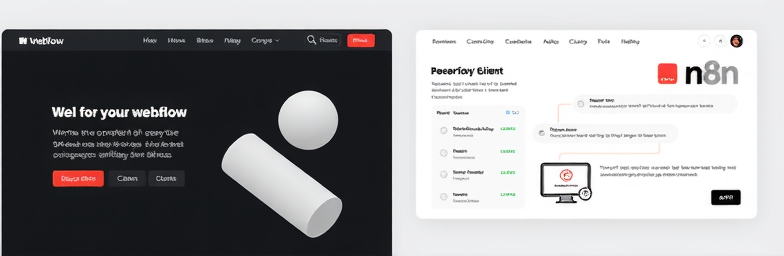
- Clarity of offer: Say exactly what you do, for whom, and the outcome. Example: “Webflow websites and n8n automations that turn clicks into pipeline for B2B teams.”
- Decision-focused structure: Navigation and pages that mirror how buyers think: Problem → Solution → Proof → Next step. Give multiple entry points (demo, pricing, case studies, resource download).
- Right-sized CTAs: Primary (Book a demo), Secondary (See pricing), and Low-friction (Get the checklist). Meet visitors where they are.
- Frictionless capture: Short forms, progressive profiling, or let qualified users book directly to calendar.
- Proof that moves risk: Outcomes, specific metrics, recognizable logos, side-by-side before/after, and video snippets near the CTA.
- Fast, accessible, readable: Lightweight assets, disciplined animation, high contrast, mobile-first typography.
- Measurement: Track events, scroll depth, CTA clicks, and form drop-off. Pipe insights into your CRM so sales sees context.
The automation that closes the loop
Most “leaks” happen after the click. That’s why we pair Webflow builds with n8n automations to capture, route, and respond in minutes — not days. A typical flow:
- Form submit or Calendar booking → validate and enrich company data.
- Score against your ICP (industry, size, intent signals).
- Notify the right owner in Slack with context and suggested next steps.
- Create/Update the record in your CRM with source and page journey.
- Auto-confirm via email with prep materials, a short video, and a calendar hold.
- Nurture non-demo visitors (e.g., downloaded a guide) with a 3-email sequence and a time-bound follow-up CTA.
Business impact: faster replies, fewer no-shows, cleaner data, and a pipeline that doesn’t depend on manual follow-up.
A quick audit you can run this week
- Message test: Can a new visitor explain what you do in one sentence after five seconds?
- CTA map: Does every key page have a primary, secondary, and low-friction next step?
- Form friction: Cut your required fields in half. Track completion rate before/after.
- Proof proximity: Is there a relevant proof point within one scroll of every CTA?
- Speed check: Audit LCP on mobile. Compress media. Remove nonessential scripts.
- Follow-up speed: Measure time-to-first-response. If it’s hours, you’re leaking.
The WeCraft way
WeCraft Studio builds high-performing Webflow sites and the automations that make them sell.
- Diagnose: We audit messaging, analytics, UX, and handoff to sales. No fluff — just where revenue is leaking.
- Design for decisions: We structure pages, CTAs, and proof around buyer intent. Modern look, yes — but built for conversion.
- Automate the follow-through: With n8n, we score, route, and nurture so every qualified click gets handled instantly.
- Prove and iterate: Clear baselines, A/B testing, and reporting that ties design changes to revenue outcomes.
Bottom line
If your website looks modern but pipeline tells a different story, you don’t need more polish — you need a conversion system. We’ll build both: the Webflow experience that wins trust and the n8n automation that turns interest into revenue. Ready to stop the leaks?
Insights That Sparkle
Stay inspired with fresh ideas, industry tips, and behind-the-scenes stories. Our blog is where we share trends, knowledge, and a touch of creativity to help you grow, glow, and stay ahead.
%20(1).png)

.png)
.png)
.png)
%20(1).png)