


The mistake founders keep making with automation: tasks over systems
Founders love quick wins. A new Zap here, a calendar auto-invite there, a gorgeous Webflow site with slick animations. Then the pipeline stays flat and everyone wonders what went wrong. The problem is simple: you automated tasks, not a system. And a beautiful website without a conversion system is just an expensive brochure.
Pretty does not equal performance
Design matters. But design that does not move a buyer from interest to action is decoration. The most common failure we see: sites that look elite and convert like a postcard. Why? Because the fundamentals are missing. No clear value proposition above the fold. Multiple competing calls to action. No offer that meets the visitor where they are. No proof stacked near the decision. No instrumented events to show what is working. And worst of all, no follow-up when a lead raises their hand.
A high-performing site is not about color palettes and motion. It is about message clarity, friction control, and a deliberate path to the next step. A site either creates qualified pipeline or it does not. Aesthetics support that mission; they do not replace it.
Tasks vs systems
Task automation is when you wire a form to ping Slack. Or you auto-create an invoice after a deal closes. Useful, but shallow. System automation is the end-to-end flow: attract the right traffic, capture intent with the right offer, qualify and route instantly, follow up with context, and measure the whole loop so you can improve it.
Here is the difference in practice. Task thinking: new lead submits a form, Slack notification fires, someone replies when they have time. System thinking: traffic source is captured, lead is enriched and scored, hot leads are routed within minutes, a tailored email goes out, a calendar is offered with dynamic availability, and the handoff to proposal and onboarding is automatic. The result is faster response, higher show rates, and fewer dropped opportunities.
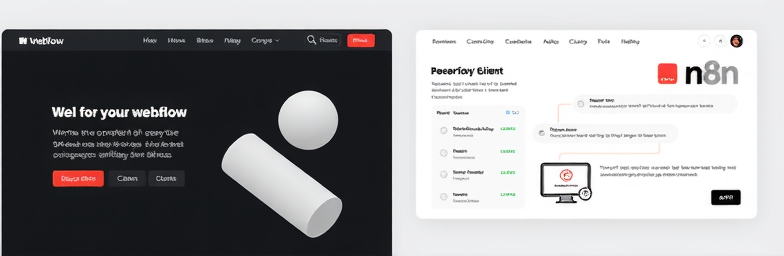
What a conversion system looks like (Webflow + N8n)
1) Positioning first. Your headline should tell the right visitor they are in the right place and why now. One primary call to action, one secondary for lower-intent users.
2) Offers that match intent. Not everyone is ready to book a call. Add micro-conversions: a pricing guide, a calculator, a 5-minute audit. These give value and qualify interest.
3) Instrumentation. Every form, click, and CTA is tracked. UTM parameters are persisted so you know which channels create SQLs, not just traffic.
4) Routing and response. With N8n, new leads are enriched with company data, scored against your ICP, and sent to the right owner with a service level alert. Hot leads trigger a personal email within minutes and a text notification if no response. No more manual triage.
5) Lifecycle workflows. When a meeting is booked, prep is auto-generated, notes are synced to your CRM, proposals are templated, and follow-ups are sequenced. If a deal stalls, nudges go out with context. When a client signs, onboarding checklists and timelines kick off without you lifting a finger.
6) Feedback loops. Dashboards show conversion by page, source, and offer. You test headlines, reorder proof, and refine forms based on actual behavior, not opinion.
The business impact is not subtle: response times drop under five minutes; demo show rates climb; qualification becomes consistent; forecasting gets cleaner; your team spends time on conversations, not copy-pasting.
Common founder traps (and the fix)
- Trap: Launching a stunning site with vague messaging. Fix: Start with positioning and a single, obvious path to the next step.
- Trap: Automating the loudest task. Fix: Map the whole journey, identify the bottleneck, then automate the constraint first.
- Trap: Tool chasing. Fix: Pick a thin, durable stack. Webflow for speed and control. N8n for orchestration. CRM for truth. Analytics for learning.
- Trap: One-size-fits-all CTAs. Fix: Add micro-conversions and right-size the ask to the visitor’s intent.
- Trap: No measurement. Fix: Track events, persist source, and tie every experiment to pipeline, not vanity metrics.
The WeCraft way
At WeCraft Studio, we build systems that sell. We design modern, fast Webflow sites that make the message undeniable, and we wire N8n automations that handle the boring, critical work: enrichment, scoring, routing, follow-up, proposals, and onboarding. It is not more tools; it is a cleaner system.
Our process is straightforward: a diagnostic to find the conversion leaks, a focused redesign to fix the narrative and path, and an automation layer that closes the loop. Two weeks in, you are seeing faster responses and cleaner data. Eight weeks in, you are tuning the system with confidence.
If you are done with pretty and ready for performance, build the system. We will help you design it, ship it, and measure it.
Insights That Sparkle
Stay inspired with fresh ideas, industry tips, and behind-the-scenes stories. Our blog is where we share trends, knowledge, and a touch of creativity to help you grow, glow, and stay ahead.
%20(1).png)

.png)
.png)
.png)
%20(1).png)