


Redesign beats repair: the hidden cost of patching old sites
If you're a founder, you’ve likely asked a developer to “just fix this one thing.” A plugin here, a custom snippet there, a quick content tweak. Months later, you have a pretty homepage sitting on top of fragile plumbing. Leads leak. Reporting is murky. Your team compensates with manual work. The bill? You pay it every day in missed opportunities.
The hidden cost of patching
Repairing an old site feels cheaper because the invoice is smaller. But the long-term cost shows up in places your P&L can’t separate easily:
- Technical debt: Plugins, hacks, and outdated themes slow performance and break unpredictably after updates.
- Inconsistent UX: Years of incremental changes create a maze of CTAs, messages, and forms that confuse visitors.
- Manual work: Leads land in inboxes. Follow-ups happen “when someone has time.” Speed-to-lead drops, so do close rates.
- Blind spots: Analytics aren’t connected end-to-end. You can’t see which pages or campaigns drive revenue, only traffic.
- Brand drag: A dated or disjointed site erodes trust before you ever get to the sales call.
Pretty vs. profitable
Aesthetics are table stakes. The site needs to look modern and on-brand. But design without deliberate conversion systems is decoration.
Here’s a common pattern: a striking hero image, vague headline, three competing CTAs, a form with twelve fields, and no scheduling option. Submissions trickle in, then sit stale because they weren’t routed, enriched, or followed up automatically. That isn’t a marketing problem. It’s a systems problem.
What actually makes a website convert
- Clarity: A precise value proposition and messaging hierarchy. Visitors should know what you do, for whom, and why it’s better—within five seconds.
- Focused paths: One primary action per page (book a call, start a trial, request a quote) with frictionless UX.
- Proof: Case studies, outcomes, and logos that reduce perceived risk at key moments, not dumped in a separate tab no one opens.
- Speed and stability: Fast load times, clean code, responsive layouts. Performance is conversion.
- Frictionless capture: Short forms, progressive profiling, or direct scheduling. Ask for what’s essential, then earn the rest later.
- Measurement: Events, funnels, and attribution configured to show which pages and campaigns create pipeline—not just pageviews.
- Speed-to-lead: Automatic routing, alerting, and follow-up so the first touch happens while intent is high.
The WeCraft way
WeCraft Studio rebuilds the system—not just the surface.
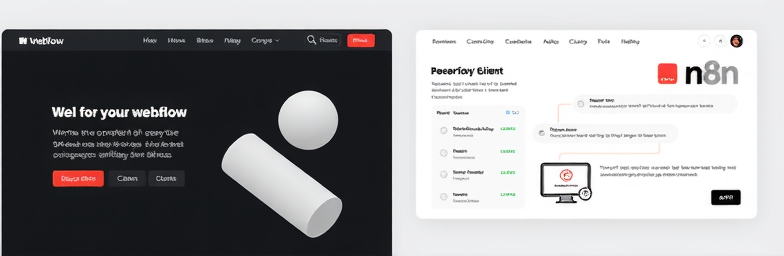
Modern Webflow architecture
- Component-driven design for consistency and rapid iteration.
- CMS structures for case studies, services, and resources that your team can update without developers.
- Performance-first build: clean HTML/CSS, optimized assets, accessible patterns, and sane SEO foundations.
Smart automation with n8n
- Lead ops pipeline: Validate and de-duplicate form submissions, enrich key fields, and sync to your CRM or Notion/Airtable.
- Instant alerts: Notify the owner in Slack with context (page source, campaign, intent signals) and assign next steps.
- Speedy follow-up: Auto-send a tailored email with a calendar link; if there’s no booking, nudge at smart intervals.
- Operational triggers: Create tasks, push prospects into the right nurture sequence, and update dashboards—without human copy/paste.
The result is a site that looks premium and operates like a revenue machine. Marketing focuses on message-market fit, not wrestling widgets. Sales gets warmer, better-qualified conversations—faster.
Redesign vs. repair: a simple decision grid
Choose redesign when:
- Your brand, offering, or ICP has evolved.
- Page speed, mobile experience, or editor usability is poor.
- You can’t measure what drives pipeline.
- Leads depend on manual triage and inconsistent follow-up.
- You’re stacking fixes on top of fixes to “get through the quarter.”
Choose a repair when:
- The foundation is sound, performance is strong, and you need targeted messaging or UX adjustments.
- Your analytics are clean and you can tie changes to measurable impact quickly.
If you’re uncertain, an audit will tell you in a week. If the site is a leaky bucket, adding more water (traffic) won’t help. Replace the bucket.
What founders actually want
You don’t want “a new site.” You want fewer lost leads, faster sales cycles, cleaner data, and a system your team can run without heroics. That’s why redesign beats repair: it aligns surface, structure, and systems so every click has a job and every handoff is automatic.
How WeCraft can help
We design and build high-performing Webflow sites, then wire your lead operations in n8n so you stop losing momentum after the click. If you’re weighing patch vs. rebuild, we’ll run a focused audit and show you the exact compounding costs of the current setup—and the roadmap to a site that converts.
Insights That Sparkle
Stay inspired with fresh ideas, industry tips, and behind-the-scenes stories. Our blog is where we share trends, knowledge, and a touch of creativity to help you grow, glow, and stay ahead.
%20(1).png)

.png)
.png)
.png)
%20(1).png)