

Redesign beats optimization when your brand and ops are misaligned
Founders often come to us after months of tweaking buttons, headlines, and color palettes. The site looks great. The analytics dashboard shows traffic. Yet the pipeline is thin. That gap isn’t a design problem — it’s a misalignment problem. When your brand story and your operational reality don’t connect, optimization is lipstick. Redesign is surgery.
The pretty site, empty pipeline problem
Picture this: a polished homepage, stunning visuals, clever copy — and a single "Contact Us" form that drops inquiries into a shared inbox. No qualification, no routing, no clear next step. Sales replies in 48 hours. By then, the lead has booked with a competitor who replied in five.
This is where good-looking websites fail. Without a clear conversion system — the pathways, rules, and follow-through that turn interest into revenue — aesthetics don’t matter. Performance does.
Aesthetics vs. performance
Aesthetics is how your brand shows up. Performance is what it produces. A visually strong site earns attention; a performance-built site converts it. The difference is measurable:
- Time to first response
- Qualified lead rate
- Booked meetings per 100 visits
- Pipeline attribution clarity
- Sales cycle time and win rate
Design supports clarity and trust. Systems create outcomes.
Signs you need redesign, not another round of tests
- Your ICP isn’t obvious within 5 seconds. Prospects can’t tell who you’re for and why you’re different.
- Navigation is built around your org chart, not buyer journeys.
- One generic CTA for all visitors, regardless of intent or stage.
- Leads arrive, but sales spends hours re-qualifying, chasing, and re-keying data into a CRM.
- Follow-up is manual, inconsistent, or dependent on one person’s inbox.
If three or more resonate, optimization won’t fix it. You don’t need a shinier header — you need a re-architecture that connects brand, content, and operations.
What a converting website actually does
A converting website is a system — not a brochure. It should:
- Make positioning unmistakable: who you serve, the problem you solve, the proof you have.
- Create intentional paths by persona and intent (evaluate, compare, buy).
- Use specific offers: book a scoping call, price estimator, technical audit, or demo — not just "get in touch".
- Qualify on the way in: short, smart forms that segment by need, budget, and timeline.
- Automate the handoff: route to the right owner, push to the CRM, create tasks, trigger SLAs.
- Respond instantly: confirmation, next steps, and calendar scheduling in one flow.
- Surface social proof at the decision points: outcomes, metrics, relevant case studies.
- Measure what matters: clear attribution, funnel drop-offs, and capacity-aware scheduling.
Example: from pretty pages to a performing system
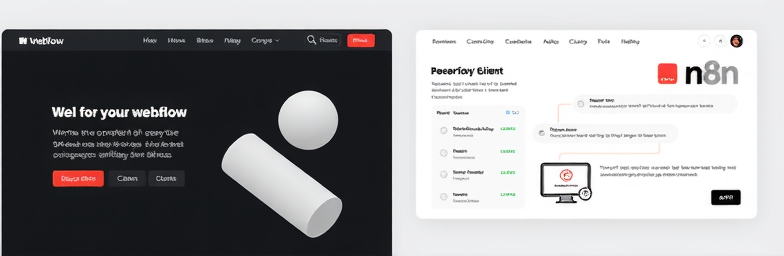
A services firm had a modern site and decent traffic, but conversion to qualified meetings hovered at 0.7%. We rebuilt their Webflow site around buyer journeys and integrated n8n automations:
- Three CTAs became one primary action per persona (book a scoping call, get a teardown, or download a pricing guide).
- Forms captured use case, team size, and timeline; low-fit leads were nurtured via resources, high-fit leads jumped straight to booking.
- n8n routed leads by service line, created deals in the CRM, posted a Slack alert, and enforced a 10-minute response SLA.
- Post-booking, clients received a prep checklist and case studies aligned to their use case.
Result: a 38% lift in qualified meetings, first response down from hours to minutes, and a shorter sales cycle because prospects arrived better prepared. Same brand. New alignment between story and operations.
When optimization is enough
Optimization shines once the fundamentals are aligned. If your messaging is clear, your offers are specific, and your handoffs are automated, then yes — test headlines, refine layout, shave milliseconds. But don’t A/B test your way out of a misaligned system.
The WeCraft way
At WeCraft Studio, we pair modern Webflow design with n8n-powered automation. We start with positioning, map buyer journeys, and build conversion paths that your ops can actually support. The outcome isn’t just a prettier site — it’s a faster, clearer revenue engine.
A quick self-check
Ask yourself:
- Can a qualified buyer book the right next step in under 60 seconds?
- Does every form route to the right owner with context in your CRM?
- Is your first response under 10 minutes during business hours?
- Do different personas see different offers and proof?
- Can you point to one metric your website improved last quarter besides traffic?
Conclusion
If your brand story and operations don’t line up, optimization is a distraction. Redesign the system: clarify the message, structure the journeys, and automate the motion from click to close. When you’re ready to make your website perform — not just impress — we’ll build it with you.
Insights That Sparkle
Stay inspired with fresh ideas, industry tips, and behind-the-scenes stories. Our blog is where we share trends, knowledge, and a touch of creativity to help you grow, glow, and stay ahead.
%20(1).png)

.png)
.png)
.png)
%20(1).png)