


If you’re still on Shopify for content, you’re wasting money
Shopify is excellent for checkout. It is not a content platform. If your blog, landing pages, resources, and case studies live inside Shopify, you’re paying for slow pages, rigid templates, and a pile of apps that hide the real issue: your site looks good but doesn’t convert.
Pretty doesn’t equal profitable
Founders tell us they rebuilt the site, changed the hero, bought a premium theme, and conversions barely moved. That’s because aesthetics without clear conversion systems just make the leak look nicer. Design matters. But clarity, speed, path to purchase, and measurement matter more.
Where Shopify quietly costs you on content
- Editorial friction: Non-technical teams wrestle with sections, blocks, and theme constraints. Simple landing pages become tickets. Momentum dies.
- Rigid structure: Blog URLs, categories, and content types are limited. Modeling case studies, resources, and landing pages gets hacky, which hurts SEO and internal linking.
- Theme and app bloat: Each app injects scripts. LCP and CLS climb. Slower pages mean lower quality scores and fewer conversions from the same ad spend.
- Testing is expensive: A/B testing and personalization typically require paid apps or dev work. So you guess instead of iterate.
- Content modeling is awkward: Metaobjects help, but marketers still hit walls when building rich, modular content at speed.
- Attribution gaps: Form submissions, UTM capture, and lead routing often rely on duct-taped apps. Data is messy, follow-up is slow.
What actually makes a website convert
- Clarity first: A sharp promise, a clear offer, and a single next step above the fold.
- Speed and stability: Sub-2s LCP, minimal layout shift, and no third-party script sprawl.
- Intent-matched content: Landing pages aligned to queries and campaigns, not generic product pages for every use case.
- Proof and specificity: Social proof with numbers, outcomes, and process. Not vague praise.
- Capture and nurture: Forms that collect the right fields, instant routing to CRM, and automated follow-up.
- Measurement loop: Events, cohorts, and content-level ROI so every new page launches with a hypothesis and a scoreboard.
The WeCraft way: split the stack
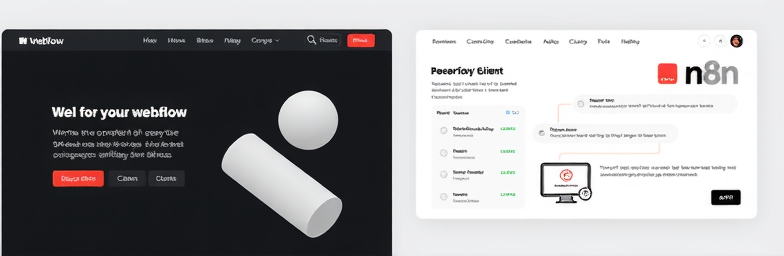
Use Shopify for what it does best: inventory and checkout. Use Webflow for what makes you money: content, landing pages, and speed. Connect them cleanly and automate the busywork.
- Webflow for content and performance: Build fast, modular pages for campaigns, resources, and case studies. Editors publish without tickets. Clean markup and responsive images improve Core Web Vitals.
- Shopify for commerce: Use Storefront API or Buy Buttons to hand off to Shopify checkout. Keep PDPs where they belong; move education and acquisition pages to Webflow.
- n8n for automation: Sync Webflow forms to your CRM, enrich with UTM and source, score leads, post alerts to Slack, and trigger email sequences. Push product or content data between systems on a schedule.
- Analytics and testing: Ship experiments quickly in Webflow, track events, and roll winners into templates. Fewer paid apps, more learning per week.
Example impact
Typical founder scenario: A DTC brand runs its blog and landing pages on a heavy Shopify theme with five marketing apps.
- App spend drops when testing, forms, and landing pages move to Webflow. One client-side pattern we see: from roughly 200–300 per month in apps to under 75, while gaining speed.
- Organic lifts when content architecture improves. Cleaner URLs, richer internal linking, and faster pages lead to more impressions and higher click-through on informational queries.
- Conversion lift from clarity and speed. A single, focused CTA, faster LCP, and intent-specific pages commonly add fractional points to conversion that compound across paid and organic.
- Ops time saved with n8n: Automatic UTM enrichment, CRM sync, and Slack alerts reclaim hours every week from manual export-import routines.
When it makes sense to stay on Shopify for content
If you run a small catalog, have minimal content, and rarely launch campaigns, staying consolidated in Shopify might be fine. The moment content becomes an acquisition lever, splitting the stack pays for itself.
Ready to stop paying for pretty?
WeCraft Studio builds modern, high-performing Webflow frontends, keeps Shopify for checkout, and wires the data layer with n8n so your site actually sells. Modern design, smart automation, tangible business impact. If your site looks great but growth is flat, it’s time to change the system, not the shade of your buttons.
Insights That Sparkle
Stay inspired with fresh ideas, industry tips, and behind-the-scenes stories. Our blog is where we share trends, knowledge, and a touch of creativity to help you grow, glow, and stay ahead.
%20(1).png)

.png)
.png)
.png)
%20(1).png)