


Stop patching your old site - it's costing you pipeline.
If you are still polishing the corners of an aging website, you are paying a quiet tax every month. The site may look fine. It may even be beautiful. But if it is not engineered to turn qualified attention into meetings, trials, or quotes, it is leaking pipeline.
Pretty does not equal pipeline
Design wins attention. Systems win revenue. Most underperforming sites share the same pattern: strong visuals, vague message, scattered calls to action, and a contact form that sends a generic email. That is not a growth engine. It is a brochure.
A founder we spoke with had a striking site and plenty of traffic from paid and content. Demo rate hovered around 0.8%. We rebuilt the conversion architecture, clarified the offer above the fold, introduced a clear primary CTA, re-ordered proof and outcomes, and automated lead routing. Demo rate moved to 2.6% within six weeks. Same traffic. Different system.
What a conversion system actually includes
A high-performing site is less about pixels and more about choreography. The pieces work together:
- Positioning and offer clarity above the fold: who it is for, the outcome you deliver, and the next action.
- CTA strategy: one primary action per page, consistent placement, secondary paths for lower-intent visitors.
- Proof where it matters: logos near the hero, outcome-driven testimonials near pricing or demo, case studies near decision points.
- Friction-smart forms: multi-step or progressive profiling, autofill, instant validation, and a calendar handoff without extra clicks.
- Speed and usability: Core Web Vitals, accessible components, responsive behavior that feels native on mobile.
- Measurement: event tracking, funnels, scroll depth, heatmaps, and a single source of truth for conversion reporting.
- Automation: enrichment, routing, deduping, scoring, and immediate follow-up using tools like n8n to connect forms, CRM, Slack, and calendars.
When these elements are in place, you stop guessing and start compounding. Changes become experiments, not opinions.
The hidden tax of patching
Patching feels cheaper. It rarely is. You pay in invisible ways:
- Lost buyers: high-intent visitors who cannot find the next step within 8 seconds will bounce.
- Slow ops: manual triage of form fills means prospects wait hours for a reply. Speed to lead wins deals.
- Inconsistent follow-up: no routing logic means SDRs miss or duplicate leads.
- Ad waste: you optimize campaigns into a leaky page and blame the channels.
- Technical drag: plugin sprawl, theme conflicts, and band-aid fixes that break on every update.
Run the math. With 10,000 monthly visitors, a move from 1.0% to 2.5% primary conversion means 150 more demos each month. At a 20% close rate and a 20k average deal size, that is roughly 600k in additional pipeline monthly. Patching does not get you there. System design does.
When to rebuild instead of patch
Choose a rebuild if at least two of these are true:
- Your headline could apply to any competitor and your primary CTA changes page to page.
- Marketing cannot ship copy or layout changes without developer time.
- Mobile speed feels sluggish and scores poorly on Core Web Vitals.
- You cannot see end-to-end attribution from visit to opportunity.
- Leads arrive unqualified and scheduling is a back-and-forth email thread.
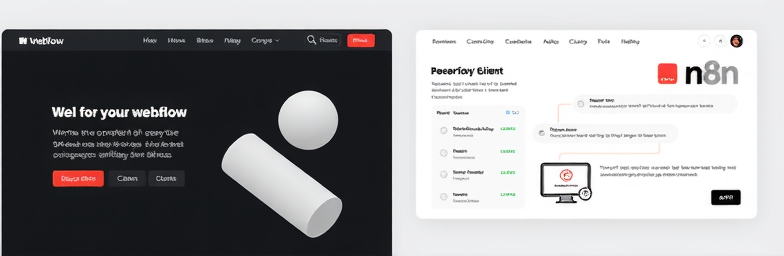
A modern stack solves this. We use Webflow for speed, control, and performance. We use n8n to automate the work around the click: enrichment, routing, scheduling, and reporting that your team can trust.
The WeCraft way
WeCraft Studio builds systems, not just sites:
- Discovery and positioning: ICP clarity, jobs-to-be-done, and the narrative that moves your best buyers.
- Conversion architecture: page flows, content hierarchy, and proof placement mapped to buyer intent.
- High-performance Webflow build: component library, CMS structure, accessibility, and Core Web Vitals optimized.
- Smart automation with n8n: enrich leads, dedupe, assign by territory or product line, push to CRM, notify in Slack, and auto-book meetings.
- Measurement and iteration: event schema, dashboards, and test plans so improvements never stop at launch.
The result: modern design, smart automation, and tangible business impact. A site your team can evolve weekly, and a system your pipeline can feel.
Bottom line
If you are still patching, you are choosing slow losses over decisive wins. Replace the brochure with a conversion system. If you want a partner who blends design with operations and ships outcomes, we should talk.
Insights That Sparkle
Stay inspired with fresh ideas, industry tips, and behind-the-scenes stories. Our blog is where we share trends, knowledge, and a touch of creativity to help you grow, glow, and stay ahead.
%20(1).png)

.png)
.png)
.png)
%20(1).png)