

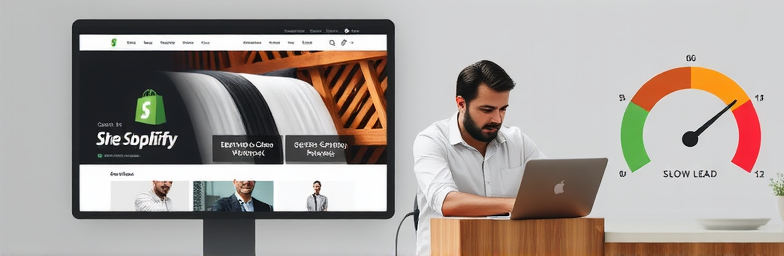
The hidden cost of Shopify themes: speed, control, and credibility
A premium Shopify theme can make your store look polished on day one. But for many founders, the honeymoon ends fast: ad spend climbs, sessions grow, and conversions flatline. The problem isn’t how your site looks. It’s the invisible cost of themes—speed, control, and credibility—that quietly taxes every visitor and undermines trust.
A pretty site without a system is a liability
Design without a conversion system is art. You need a sales engine. That means a clear value proposition above the fold, fast-loading pages, frictionless paths to key actions, proof at decision points, and instrumentation that shows what’s working. When a site is built around a theme’s constraints instead of your customer’s journey, your pages can be beautiful and still underperform.
Speed: theme bloat taxes every visitor
Themes are built to sell versatility: sliders, mega-menus, animations, multiple product layouts. You only need a few of those, but you load all of them—plus the six to ten apps you added for reviews, upsells, popups, tracking, and analytics. The result is render-blocking scripts, oversized images, duplicated libraries, and layout shifts that punish your Core Web Vitals.
Speed isn’t vanity. It’s money. A one-second delay increases bounce and drops add-to-cart rates. Multiply that by paid traffic and the math hurts. Example: 10,000 monthly visits at a 2% conversion rate is 200 orders. If speed issues drag you to 1.6%, that’s 160 orders. With a $100 AOV, you just lost $4,000 this month. That’s not theoretical—slow pages quietly siphon revenue every day.
Control: you rent your layout from the theme
Themes give the illusion of flexibility. In practice, you’re rearranging pre-built blocks and praying the update doesn’t break your customizations. Want to change the mobile hero hierarchy? Add a context-specific banner on two collections? Align product media and copy differently for high-ticket SKUs? You’re either hacking around the theme or waiting on a developer to fight it.
That lack of control slows decision-making. Teams stop iterating because every change feels expensive. Your marketing velocity dies exactly when you should be testing offers, headlines, and proof.
Credibility: micro-friction erodes trust
Customers may not read your code, but they feel it. Jittery layout shifts, mismatched fonts from an app modal, sticky bars that cover CTAs, and buttons that don’t respond instantly—these tiny frictions signal instability. Credibility is fragile: if the site feels flimsy, your brand feels risky. Luxury brands especially pay the price here; slow or shaky equals cheap.
What actually makes a site convert
- Message hierarchy with ruthless clarity: a crisp promise, visual proof, and a single primary action per screen.
- Speed as the default: lean assets, deferred scripts, optimized images, stable layout, and measurable Core Web Vitals.
- Purposeful paths: navigation and internal links that move visitors from interest to product to checkout with no dead ends.
- Proof and reassurance at the moment of doubt: reviews, policies, delivery timelines, and guarantees embedded where decisions happen.
- A data loop: events that track scroll depth, add-to-cart, variant changes, and form interactions—so experiments are informed, not guesswork.
- Automation behind the scenes: n8n flows that route leads to Slack, sync waitlists to CRM, trigger follow-ups on abandoned checkouts, and keep inventory and notifications in lockstep. Less manual work, fewer mistakes.
The WeCraft way
WeCraft Studio builds systems that ship fast and sell faster. Our approach:
- Performance-first build: minimal, purposeful JavaScript; deferred non-critical scripts; compressed media; and stable layouts that pass Core Web Vitals.
- Real control: a modular component library so your team can launch pages, test variants, and update offers without breaking the site.
- Right tech for the job: high-performing Webflow front-ends for storytelling and landing pages, integrated with Shopify where it belongs (catalog, cart, checkout) via lightweight embeds or APIs when appropriate.
- Measurement baked in: analytics events mapped to your funnel so you can see exactly where revenue is leaking and fix it.
- Smart automation: n8n workflows that eliminate repetitive ops—lead routing, UGC collection, restock alerts, order tagging, and post-purchase journeys.
A quick founder checklist
- Do your key pages load fast on 4G, not just your office Wi‑Fi?
- Can your team launch a new landing page and test a headline today without developer help?
- Does every critical interaction (menu, filters, add-to-cart) respond instantly and consistently on mobile?
- Are you tracking the moments that matter and acting on them automatically?
Conclusion
The hidden cost of Shopify themes isn’t the license fee. It’s the drag on speed, the limits on control, and the trust you lose in a split second. If you’re ready to trade generic flexibility for targeted performance, WeCraft will design the system: modern design, smart automation, and measurable impact. Let’s turn your site from a pretty brochure into a reliable growth engine.
Insights That Sparkle
Stay inspired with fresh ideas, industry tips, and behind-the-scenes stories. Our blog is where we share trends, knowledge, and a touch of creativity to help you grow, glow, and stay ahead.
%20(1).png)

.png)
.png)
.png)
%20(1).png)