

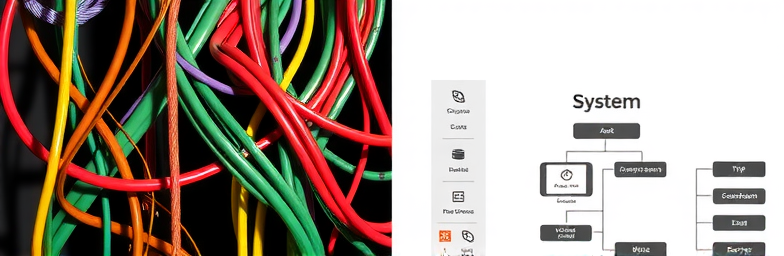
The mistake founders keep making with Zapier-style automation chains
You launch a gorgeous website, hook the form to a few Zaps, pipe notifications to Slack, and call it a system. For a while, it feels fine—until leads go missing, duplicates pile up, a calendar link fails quietly, or a paid campaign spikes and your chain collapses. The problem isn’t your tools. It’s thinking a chain of quick automations equals a conversion system.
Pretty doesn’t convert without a system
Design matters. But aesthetics without performance is an expensive brochure. Conversion comes from clarity and orchestration: a message that speaks to a specific buyer, one primary CTA per page, fast load times, social proof near moments of doubt, and a post-click path that’s intentional. “Nice” doesn’t move revenue—clear does. “Sleek” doesn’t retain attention—speed and relevance do.
A high-performing site answers three questions fast: What do you solve? For whom? What happens next? If the next step is vague or fragile, you’ve built a museum, not a funnel.
The trap: linear chains for non-linear buyers
Zapier-style chains are linear: if this, then that, then another that. Real buyers are not. They abandon, return from a remarketing ad, book then reschedule, switch devices, or reply to an old email. Meanwhile, your chain breaks on a rate limit, a field rename, or a third-party outage. No logging. No retries. No deduplication. Just silent failure.
What looks lean in the beginning becomes brittle as you add conditions: tag here, enrich there, block spam, branch for enterprise, push to CRM, ping Slack, update a sheet. Each link works individually; together, they’re a liability. You don’t have a system—you have a Rube Goldberg machine handling revenue-critical events.
What a converting system actually looks like
A real system is event-driven, observable, and resilient:
- Clear offer and path: single primary CTA on each page, contextual proof, and no dead ends.
- Smart capture: form validation, light enrichment (company, size, intent), and instant routing.
- Stateful automation: idempotency (no duplicates), retries with backoff, and alerting on failure.
- Ownership: round-robin or rules-based assignment with SLAs and speed-to-lead under five minutes.
- Post-submit experience: dynamic thank-you, calendar gating for qualified leads, and a short nurture for everyone else.
- Analytics you trust: events like Lead Captured, Call Booked, Proposal Viewed, Won—mapped consistently across web, CRM, and marketing tools.
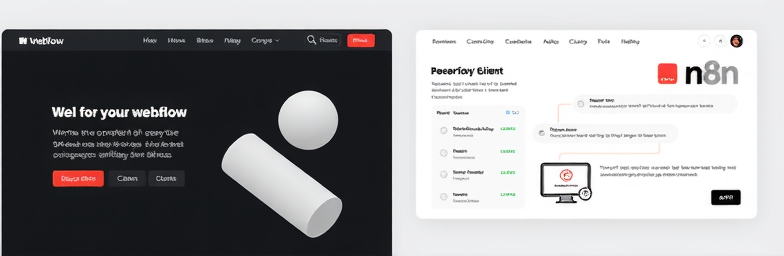
In our world, Webflow handles the fast, conversion-focused front end. n8n orchestrates the flow: capture → enrich → score → route → notify → log → recover on failure. The difference is not the logo on the tool—it’s the architecture.
A quick reality check (and a better pattern)
Common founder setup: Webflow form → Zapier → CRM + Slack. Missing pieces: deduplication, enrichment, qualification, error handling, and a post-submit journey. Result: reps chase unqualified leads, high no-show rates, and nobody knows where drop-off happens.
A stronger pattern: Webflow form → n8n webhook with validation → enrichment (e.g., company, role) → score and branch: if qualified, show calendar and assign owner; if not, deliver a helpful next step and capture intent for nurture. Log every step, retry failures, alert the team on exceptions. Track the full funnel from visit to revenue.
What this looks like in practice
Example scenario: A B2B services firm ran a polished site with stacked Zaps. Leads were slow to reach sales, duplicate contacts skewed reporting, and 30% of booked calls no-showed. We rebuilt the system: clarified the on-page offer and CTA hierarchy in Webflow, moved orchestration into n8n with enrichment and scoring, gated calendar access for ICP leads, sent instant owner alerts with context, and added a two-touch confirmation flow. Outcomes you can expect from this approach: faster speed-to-lead, fewer no-shows, cleaner CRM data, and clarity on where the funnel leaks—so you can fix what actually matters.
Audit your setup in 10 minutes
- Can you name your primary CTA for each key page without looking?
- Does every form send to one source of truth (not five tools directly)?
- Do you dedupe contacts before CRM creation?
- If an API call fails at 2 a.m., who gets alerted—and does it retry?
- Is speed-to-first-touch under five minutes during business hours?
- Is there a different post-submit path for qualified vs. not-yet-qualified?
- Can you report Visit → Lead → Meeting → Proposal → Won, consistently?
The WeCraft way
WeCraft Studio builds for outcomes: Modern design + Smart automation + Tangible business impact. We design Webflow sites that are conversion-first, then wire them to n8n automations that are observable, recoverable, and maintainable. You get a clean offer, a clear path, and a system that doesn’t fall apart when your traffic—or ambitions—scale.
Zapier still has a place for lightweight, non-critical tasks. But if revenue depends on it, you need a system, not a chain.
Insights That Sparkle
Stay inspired with fresh ideas, industry tips, and behind-the-scenes stories. Our blog is where we share trends, knowledge, and a touch of creativity to help you grow, glow, and stay ahead.
%20(1).png)

.png)
.png)
.png)
%20(1).png)