


What nobody tells you about Webflow's impact on operational costs
Founders love the moment a new site goes live. It looks modern. It finally feels like the brand you had in your head. Then two weeks pass and the inbox is quiet. Your team is still copying form submissions into a CRM. Marketing still needs a developer for basic updates. The site is beautiful, but it is not moving the numbers.
Aesthetics without systems is the most expensive website you can buy
Design attracts attention. Systems convert attention into revenue and time saved. When a site is built for aesthetics alone, you pay hidden costs every day:
- Manual follow-up: Someone copies leads from forms to your CRM and pings sales in Slack. 30 minutes a day becomes 11+ hours a month.
- Developer dependency: Simple content edits become tickets and retainers. Momentum dies, updates lag.
- Leaky analytics: No event tracking, no attribution, no idea what works. You keep spending on guesswork.
- Friction in the funnel: CTAs that don’t route by intent, slow pages, dead ends that bleed demand.
Add it up. If one coordinator spends 2 hours a day on admin at $35/hour, that is roughly $1,400 per month in invisible cost. And it scales with growth.
Where Webflow saves money — and where it doesn’t
Used well, Webflow cuts operational drag:
- Hosting, CDN, SSL, and security are handled natively. No plugin patch days, fewer maintenance surprises.
- A component library means marketing can ship updates without a developer. Hours drop to minutes.
- CMS collections standardize content so you can publish at scale and keep quality consistent.
But Webflow alone does not fix a weak funnel or disjointed operations. If you treat it as a prettier brochure, you will still leak time on manual tasks and your conversion rate will stay flat.
What actually makes a website convert
High-performing sites blend clear messaging, fast UX, and automation behind the scenes. The essentials:
- Positioning that says who it is for and why you are different in a single screen.
- Intent-based pathways: Pricing, demo, and technical buyers each get a tailored route and CTA.
- Speed and clarity: Sub-2s loads, scannable sections, precise microcopy, ruthless removal of fluff.
- Trust architecture: Specific outcomes, named clients, numbers that matter, not generic logos.
- Frictionless actions: Book a call, generate a quote, or try a calculator without hunting for it.
- Integrated automation: Forms push to your CRM, enrich the lead, notify the right rep, and fire a follow-up sequence automatically.
- Measurement: Events, goals, and cohorts wired from day one so you can iterate on evidence.
Concrete examples founders feel instantly
Example 1: A B2B services firm moved from a plugin-heavy WordPress site to Webflow. We added a pricing estimator that collects scope, auto-scores the lead, and routes qualified requests. Webflow handles the front-end; n8n posts to HubSpot, enriches with Clearbit, alerts sales in Slack, and sends a tailored email with available calendar slots. Result: manual triage dropped by 20 hours per month, first-response time fell from 18 hours to under 1 hour, and demo conversion rose from 0.8% to 2.3%.
Example 2: A founder-driven SaaS had a beautiful site but no follow-through. We rebuilt the IA, clarified the value prop, added social proof tied to metrics, and wired event tracking. Lead magnets sync to the CRM, n8n segments by intent, and a 3-touch nurture runs until a meeting is booked. The team now publishes updates without dev help, and ops costs tied to site changes effectively went to near-zero.
The total cost of ownership lens
Webflow reduces TCO when combined with conversion systems:
- Fewer vendors: Hosting, security, and performance are included. No plugin roulette.
- Faster iteration: Marketing owns updates; engineering focuses on the product.
- Automation dividend: Every form, booking, or quote triggers work you no longer do manually.
Without that last piece, the site remains a cost center dressed as an asset.
The WeCraft way
We build high-performing Webflow sites that cut operational waste and increase conversion:
- Strategy first: Audit your funnel, ICPs, and bottlenecks. No guesswork.
- Conversion architecture: Clear messaging, intent-led navigation, fast pages, strong proof.
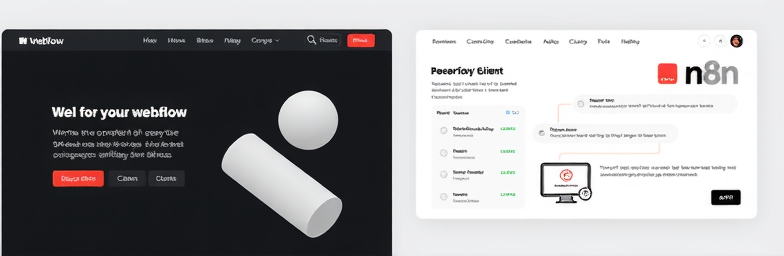
- Systems behind the pixels: n8n automations connect Webflow to your CRM, billing, Slack, Notion, and scheduling. Lead scoring, routing, and follow-ups happen automatically.
- Measurement and iteration: Events, dashboards, and monthly optimization.
- Enablement: Your team is trained to ship content without a ticket queue.
Typical outcomes: 30–70% less manual admin tied to the site, updates shipped in minutes not days, and 2–3x lifts in key conversion steps.
Bottom line
A beautiful website that cannot convert or automate is an elegant expense. A high-performing Webflow build, wired to your operations, is an asset that lowers costs every week and compounds. If you are wondering why your gorgeous site is not moving the numbers, it is not the pixels — it is the missing systems. WeCraft Studio designs both, so your brand looks premium and your operations act like it.
Insights That Sparkle
Stay inspired with fresh ideas, industry tips, and behind-the-scenes stories. Our blog is where we share trends, knowledge, and a touch of creativity to help you grow, glow, and stay ahead.
%20(1).png)

.png)
.png)
.png)
%20(1).png)