


Webflow versus Shopify: the real difference founders feel post-launch
The launch feels great—new brand, crisp visuals, clean animations. Then week two hits. Traffic is steady, but leads or orders aren’t. Your team is back in Slack asking, “Why isn’t this converting?” That gap between looking good and performing well is where most sites die.
A beautiful site without a conversion system will fail
Pretty doesn’t pay payroll. Sites stall because they lack the basics: clear paths, persuasive offers, and measurable follow-up. We see it often:
- A service firm ships a stunning Webflow site with one generic contact form. No qualification, no routing, no automated follow-up. Leads go cold within hours.
- A DTC brand launches a polished Shopify theme, plus 18 apps. Load time goes north of 4 seconds on mobile. Add-to-cart drops. Email capture is an afterthought.
Design opens the door; systems close the sale. Without frictionless flows—capture, nurture, segment, retarget, and attribute—your website is just a digital brochure.
Aesthetics vs performance
Aesthetics is taste; performance is process. Performance looks like:
- Clarity over cleverness: above-the-fold answers what, for whom, and why now.
- Speed: sub-2s mobile load, compressed assets, minimal blocking scripts.
- Focused paths: one primary CTA per page, with contextual micro-CTAs.
- Evidence: reviews, outcomes, numbers, logos, and short case proof.
- Measurement: event tracking that ties each click to revenue or pipeline.
- Automation: smart follow-ups that adapt to behavior, not a single “thanks for your message.”
When Webflow feels better post-launch
Webflow shines when you need brand control and fast iteration without engineering overhead—especially for content-led growth or complex storytelling.
- Marketing speed: ship a new pricing page, variant test a headline, or spin up a campaign hub without submitting a dev ticket.
- Component discipline: a real design system in Webflow means fewer one-off pages and faster consistency.
- Custom funnels: build comparison pages, calculators, or gated resources tied to your CRM and scoring. No theme constraints.
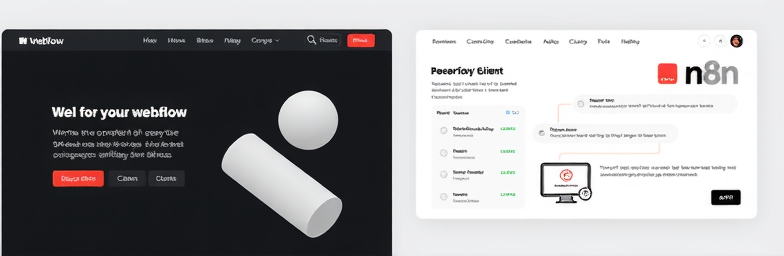
Common outcome: a B2B founder moves to Webflow, pairs forms with enrichment and routing via n8n, and sees qualified demos go up while sales gets cleaner context.
When Shopify feels better post-launch
Shopify wins where checkout is the product: native payments, tax, shipping, inventory, and an app ecosystem built for commerce.
- Operational clarity: orders, refunds, subscriptions, and inventory in one place.
- Checkout trust: Shopify’s optimized checkout usually outperforms custom experiments.
- Ecosystem leverage: from subscriptions to fulfillment, there’s a proven path.
Typical pattern: keep Shopify for the cart and ops, and pull brand storytelling to Webflow for speed and creativity—then connect the two cleanly.
What actually makes a website convert
Tools matter, but systems win. The post-launch difference founders feel boils down to:
- Offer-Market Fit on-page: the right promise, proof, and next step for each segment.
- Speed and simplicity: fewer scripts, fewer clicks, fewer fields.
- Lifecycle logic: capture → route → follow-up → segment → retarget → measure.
- Attribution you trust: events mapped to revenue or pipeline, not vanity metrics.
Example: a DTC brand trims its app stack from 18 to 7, moves popups and quizzes to a lighter setup, connects checkout events to email/SMS flows, and rebuilds PDPs around specific objections. Same traffic; +28% revenue in 60 days.
The WeCraft way
WeCraft Studio builds the site and the system. For brand-led companies, we design high-performing Webflow sites. For commerce, we keep Shopify where it’s strongest—checkout and ops—and integrate it with Webflow when brand control matters. Then we wire the workflows with n8n so nothing falls through the cracks.
- Conversion architecture: messaging hierarchy, CTAs, and proof baked into the design system.
- Speed-first builds: minimal scripts, clean components, and a performance budget.
- Automation that serves sales: lead qualification, account routing, abandoned cart enrichment, CRM sync, and lifecycle nudges.
- Clarity in analytics: event maps, dashboards that tie pages to revenue or pipeline, and weekly insights the team can act on.
You don’t need a prettier site. You need a site that makes the next sale obvious—and an operation that moves when a prospect does. That’s the real post-launch difference.
If you’re choosing between Webflow and Shopify, choose based on where the money moves. Then build the system around it. We’ll help you design the front end, automate the back end, and tie it all to outcomes you can measure.
Insights That Sparkle
Stay inspired with fresh ideas, industry tips, and behind-the-scenes stories. Our blog is where we share trends, knowledge, and a touch of creativity to help you grow, glow, and stay ahead.
%20(1).png)

.png)
.png)
.png)
%20(1).png)