


What nobody tells you about Shopify for service businesses
Founders love Shopify. It’s beautiful, fast, and trusted. But here’s the part nobody says out loud: services don’t sell like products. A gorgeous Shopify theme with zero conversion architecture is just an expensive brochure.
The Shopify mismatch: services aren’t SKUs
Shopify is optimised for carts, SKUs, and fulfillment. Service businesses run on discovery, qualification, scope, scheduling, proposals, and deposits. When you try to force that into a product checkout, you get friction and drop‑off.
Common pitfalls we see:
- Shipping fields for services (instant confidence killer).
- No native scheduling in checkout for intensives or consultations.
- Inconsistent data: a checkout here, a form there, nothing ties to a CRM cleanly.
- Plugin sprawl just to mimic a basic intake process—then performance tanks.
Example: a consulting firm wants to take a $1,500 deposit for a strategy sprint. On Shopify, the standard flow asks for an address, sends a product receipt, and stops. No intake questions, no automatic calendar booking, no next step. The founder assumes “Shopify didn’t work.” In reality, the system was never designed for the job.
Aesthetics vs performance
Pretty is not the same as profitable. A high-end theme won’t fix weak positioning, unclear CTAs, or a dead-end lead flow. Performance comes from the path, not just the paint.
What actually moves the needle:
- Message clarity: what you do, for whom, and the outcome—in the first screen.
- Decision paths: primary CTA (Book a call), secondary (Get an estimate), and low-friction (Download price guide).
- Proof that feels real: outcome-based case studies, numbers, process visuals, named logos.
- Frictionless capture: qualification questions that route leads to the right calendar or pipeline automatically.
- Fast follow-up: instant confirmations, prep materials, and a scheduled next step—without manual chasing.
We’ve seen this repeatedly. One client redesigned on a premium theme; traffic grew 40%, leads didn’t budge. We rebuilt the conversion system: clarified the offer, added a pricing guide, embedded calendar for qualified leads, and automated nurture for the rest. Same traffic. 2.1x qualified meetings. Revenue followed.
What makes a service website convert
Your site is a system. The key components:
- Offer architecture: 1–3 clear services with outcomes, not features. “Brand in 4 weeks that shortens sales cycles” beats “Custom branding.”
- Content that scans: short paragraphs, benefit-led subheads, objection handling, and strong proof near CTAs.
- Smart CTAs: book, estimate, or learn—matched to buyer intent.
- Data you can use: forms that collect budget, timeline, and priority, pushing clean objects into your CRM.
- Analytics that tie to revenue: source/medium, UTM, form-to-opportunity tracking, and event-based reporting.
- Automation: lead scoring and routing, calendar booking, proposal prep, deposit links, onboarding tasks—triggered, not chased.
Where Shopify fits (and where it doesn’t)
Shopify can play a role—just not as a catch-all.
Good fits:
- Fixed-scope offers (e.g., $990 audits, VIP days, workshops) that need a trusted checkout.
- Deposits and retainers via subscriptions.
- Multi-currency, tax handling, and customer accounts when compliance matters.
Use it wisely:
- Keep your marketing site in Webflow for speed, design control, and structured content.
- Use Shopify Buy Buttons or direct checkout links on specific offer pages—no storefront required.
- Hide irrelevant fields for services and pre-fill customer data.
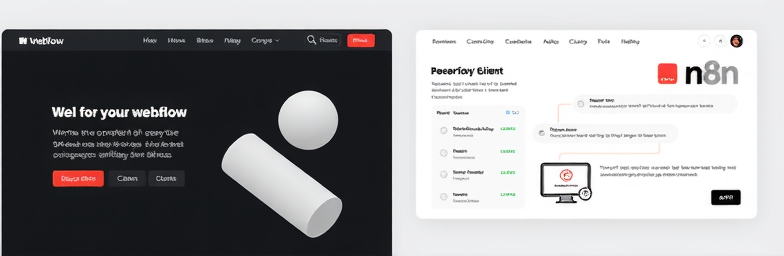
- Trigger workflows post-checkout: create deals in HubSpot, spin up a client folder, send an intake form, and book a kickoff—automatically via n8n.
And be honest: sometimes Stripe Checkout is simpler and cleaner for services. We choose the tool that reduces friction and increases conversion—period.
The WeCraft way
WeCraft Studio builds systems, not just sites. Our typical stack for services:
- Webflow for the marketing site and conversion architecture.
- Shopify or Stripe for payments when a fixed offer makes sense.
- HubSpot or Airtable as the CRM source of truth.
- n8n to orchestrate lead routing, scheduling, proposals, and onboarding.
Example: A boutique agency selling a $1,499 brand audit. We built a Webflow page with three CTAs (Book, Get Estimate, Download Price Guide). Qualified leads book instantly; others get a scoped estimate. Payment link collects deposit. n8n creates the deal, kicks off a Notion workspace, posts to Slack, and sends a prep questionnaire. Result: 34% more qualified calls, 28% faster sales cycles, and fewer no-shows.
Bottom line
If you run a service business, don’t mistake a theme for a system. Shopify can be a sharp tool in a focused flow, but it won’t design your conversion path or run your operations. That’s the work.
Want a website that actually sells your service? We’ll design the front end in Webflow, wire the back end with automation, and make the whole thing convert. That’s the WeCraft way: modern design + smart automation + tangible business impact.
Insights That Sparkle
Stay inspired with fresh ideas, industry tips, and behind-the-scenes stories. Our blog is where we share trends, knowledge, and a touch of creativity to help you grow, glow, and stay ahead.
%20(1).png)

.png)
.png)
.png)
%20(1).png)