


Why Webflow outperforms WordPress for serious businesses (and developers know).
Most founders come to us with the same story: the site looks fine, but revenue doesn’t move. Traffic trickles in. Forms go nowhere. Any simple change requires a ticket, a plugin, and a prayer. A beautiful website without a conversion system is an expensive brochure. The difference between aesthetics and performance is the difference between applause and pipeline.
A beautiful site that doesn’t convert is a cost center
Pretty pages don’t close deals. Conversions come from clarity, speed, and follow-through. That means messaging that’s laser-focused on pain and outcomes, pages that load instantly, forms that route leads to the right owners, and automation that follows up reliably. If your site can’t do this, design is just decoration.
Founder pain points we hear weekly:
- Our team can’t update copy without breaking the layout.
- Plugins fight each other; updates break forms and tracking.
- Pages are slow, mobile scores are weak, SEO suffers.
- Leads vanish into inboxes; sales hears about them days later.
Aesthetics vs performance: the metrics that move revenue
Performance isn’t subjective. It’s measured. Fast, stable sites rank better, convert more, and feel trustworthy. We look at Core Web Vitals, time to interactive, and conversion completion rates. On WordPress, hitting consistent 90+ Lighthouse scores typically requires engineering time, plugin audits, and careful hosting. On Webflow, you start closer to the target: clean semantic HTML, global CDN, image optimization, and fewer moving parts.
Can WordPress be fast? Absolutely—with the right developer, the right stack, and ongoing maintenance. But if you want predictable performance without a plugin maze, Webflow is the pragmatic choice.
Why Webflow beats WordPress for execution speed
- Editor your marketers actually use. The Webflow Editor lets non-technical teams update content safely without dismantling layouts.
- Fewer dependencies. No endless plugin chain for simple tasks. Less breakage. Fewer surprises on update day.
- Component-driven scaling. Build a library of components and CMS collections, then spin up landing pages in minutes instead of sprints.
- Secure and stable hosting. No PHP, no patch panic, no plugin vulnerability roulette.
A typical example: a B2B services firm’s WordPress stack included 27 plugins. Page speed hovered at 58 mobile. After a Webflow rebuild with componentized sections and optimized CMS, the mobile score hit 92, and qualified demo requests rose 38%—not because the hero looked prettier, but because the new flow clarified value, reduced friction, and routed leads instantly.
Conversion systems, not pages
Conversion comes from system design, not just page design. In practice:
- Message hierarchy. Clear positioning, value skimmability, objection handling, social proof and pricing clarity.
- CTA architecture. Primary and secondary CTAs matched to buying intent—book a demo for ready buyers, send a guide for evaluators.
- Form strategy. Short forms up front, progressive profiling later. Spam protection that doesn’t punish real users.
- Lead routing and follow-up. Webflow forms pipe leads to your CRM, trigger Slack alerts, and start sequences automatically.
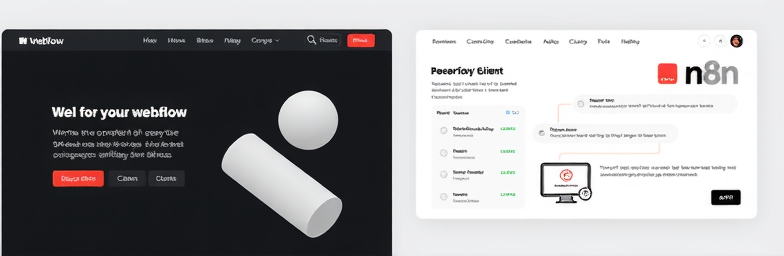
At WeCraft Studio, we pair Webflow builds with n8n automations so every conversion event becomes an operational workflow: assign the lead by territory, create the deal, tag by source, notify the owner, and send a precise first-touch email within minutes—not days.
What developers know (and won’t sugarcoat)
- Maintainability beats theoretical flexibility. WordPress can do anything. But you’ll pay for that flexibility with ongoing maintenance. Webflow covers 95% of business needs with 20% of the overhead.
- Cleaner front-end equals fewer bugs. Webflow’s semantic markup and visual CMS reduce custom code debt and CSS sprawl.
- Lower total cost of ownership. Fewer plugins, fewer conflicts, fewer hours keeping the lights on.
There are cases where WordPress makes sense—heavy editorial workflows with bespoke back-end logic, or legacy systems that are deeply tied to WP. But for most growth-focused businesses, Webflow delivers speed, stability, and control—without the maintenance hangover.
The WeCraft way
We build websites as growth systems: modern Webflow design for velocity, clear conversion architecture for revenue, and n8n automations for operational follow-through. The output isn’t just a nicer homepage—it’s faster pages, cleaner analytics, and leads that reliably reach sales.
If your current site looks good but performs like a brochure, it’s not your market—it’s your system. Move to an architecture that compounds.
Insights That Sparkle
Stay inspired with fresh ideas, industry tips, and behind-the-scenes stories. Our blog is where we share trends, knowledge, and a touch of creativity to help you grow, glow, and stay ahead.
%20(1).png)

.png)
.png)
.png)
%20(1).png)